Astronomy · Illinois

Suprabhas Narisetty

Astronomy Ph.D. student at the University of Illinois Urbana-Champaign.

Studying galaxy evolution and galaxy protoclusters with JWST.

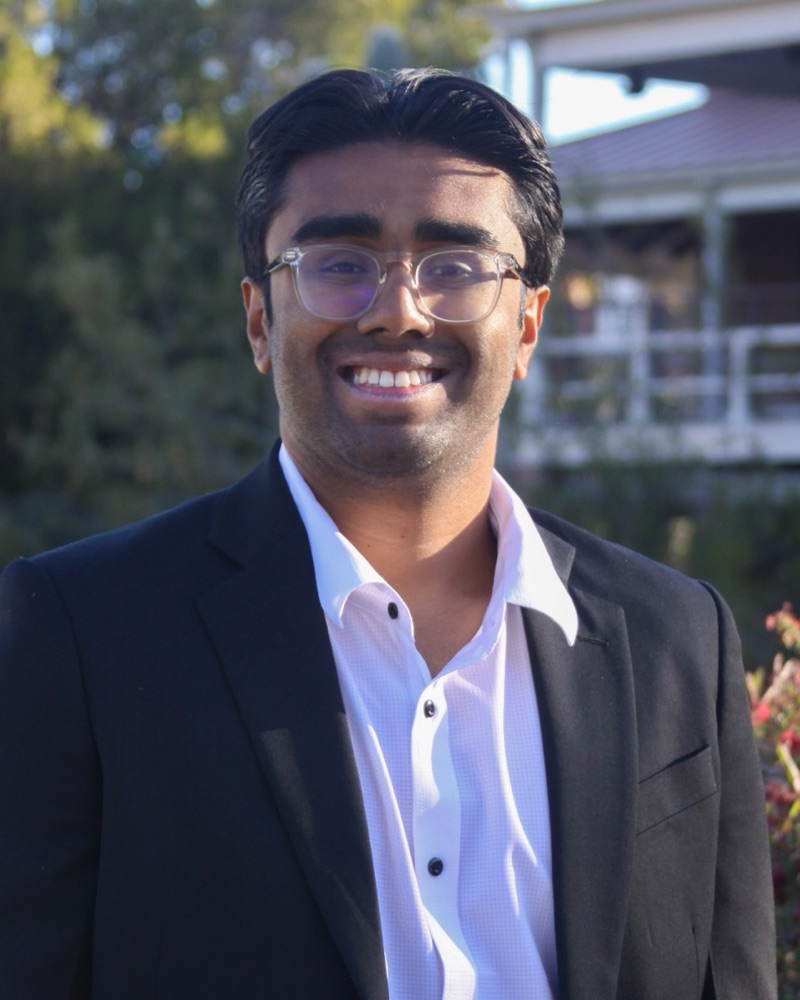
Portrait of Suprabhas Narisetty in a dark blazer and white shirt, outdoors

About

I’m an astronomy Ph.D. student at the University of Illinois Urbana-Champaign, where I work with Dr. Yue Shen on galaxy evolution using JWST observations. My current research focuses on galaxy protoclusters in the NEXUS survey, combining spectroscopy and photometry to investigate their structure and member-galaxy properties.

I graduated Magna Cum Laude from the University of Arizona in May 2026 with a B.S. in Astronomy with Honors, a B.S. in Physics, and a minor in Mathematics. At Arizona, I worked with Dr. Yongda Zhu and Dr. Eiichi Egami on Balmer-break galaxies and their connection to suppressed star formation, and with Dr. Dennis Zaritsky on the environments of ultra-diffuse galaxies. I have also worked with Dr. Joan Najita at NSF NOIRLab on chemical models of protoplanetary disks.

My research combines astronomical data analysis, spectroscopy, computational modeling, and scientific visualization.

Affiliation
University of Illinois Urbana-Champaign
Advisor
Dr. Yue Shen
Interests
Galaxy evolution, protoclusters, JWST spectroscopy
Email
ssn13@illinois.edu

Research

From galaxy protoclusters at high redshift to the chemistry of planet-forming disks.

Current University of Illinois Urbana-Champaign Advisors: Dr. Yue Shen and Dr. Ming-Yang Zhuang (postdoc) Ongoing

Galaxy Protoclusters in the NEXUS Survey

How are the earliest galaxy clusters assembled, and what are their member galaxies like?

I use JWST spectroscopy and photometry to characterize galaxy protoclusters and their member galaxies across cosmic time. The sample spans structures at roughly z ≈ 1.8–7.2, with memberships from tens to more than 100 galaxies. The goal is a paper presenting the sample and its properties, followed by further analyses.

Methods

  • JWST/NIRSpec PRISM spectroscopy combined with NIRCam photometry
  • Mapping spatial distributions and three-dimensional filamentary structure
  • Redshift estimation for galaxies with weak or absent emission lines
  • Python workflows for catalog quality checks, photometric matching, and spectral inventories
  • Python
  • JWST/NIRSpec
  • NIRCam
  • FITS catalogs
  • HPC
Jan 2025 – May 2026 Steward Observatory, University of Arizona Mentors: Dr. Yongda Zhu, Dr. Eiichi Egami Submitted to ApJ

Balmer-Break Galaxies and Departures from the Star-Forming Main Sequence

Does Balmer-break strength trace reduced recent star formation in galaxies at cosmic noon?

I analyzed JWST/NIRSpec spectra and photometry for galaxies at 1 < z < 4, using emission-line measurements and SED fitting to connect Balmer-break strength (DBalmer) to stellar populations. This work formed my honors thesis and my first-author paper.

Findings

  • Stronger Balmer breaks go with weaker Hα+[N II] equivalent widths and lower recent star formation.
  • Balmer-break strength correlates with mass-weighted stellar age.
  • At fixed stellar mass, galaxies with stronger breaks lie farther below the star-forming main sequence.
  • Python
  • GELATO
  • PROSPECTOR
  • SED fitting
  • JWST spectroscopy

Read the paper on arXiv →

Aug 2023 – May 2026 Steward Observatory, University of Arizona Advisor: Dr. Dennis Zaritsky Paper in prep · 2nd author

Environments of Ultra-Diffuse Galaxies (SMUDGes)

How do local and large-scale environments relate to the properties and evolution of ultra-diffuse galaxies?

For galaxies in the SMUDGes sample, I examined environmental measures including companion populations, significant neighboring galaxies, and cluster density, building Python analyses that combine astronomical databases and survey catalogs.

  • Python
  • SIMBAD
  • SDSS
  • Legacy Survey
  • DESI
Jun 2024 – present NSF NOIRLab Science Intern · Mentor: Dr. Joan Najita Ongoing

Protoplanetary Disk Chemistry

How do elemental abundances and physical conditions shape molecular chemistry in planet-forming disks?

I built and analyzed 108 chemical models of a disk in IC 348 across three disk radii, exploring the carbon-to-oxygen ratio, elemental depletion, ultraviolet radiation, and dust grain properties. I compared H₂O, C₂H₂, HCN, and CO₂ abundance profiles and integrated molecular columns across model parameters.

  • Chemical modeling
  • Python
  • Scientific visualization

Publications

Also listed on ORCID.

Balmer Break Measurements Trace Departures from the Star-Forming Main Sequence at 1 < z < 4 with JWST/NIRSpec

Narisetty, S., Zhu, Y., Egami, E., Carniani, S., D’Eugenio, F., DeCoursey, C., & Willmer, C. N. A.

2026 · Submitted to The Astrophysical Journal

In preparation: a study of ultra-diffuse galaxy environments in the SMUDGes sample, led by Donghyeon Khim, with me as second author.

Teaching & Outreach

Teaching

  • Teaching Assistant, ASTR 122, University of Illinois Urbana-ChampaignFall 2026

Outreach & service

  • Outreach Co-Chair, UIUC AstronomyCurrent
  • Campus Ambassador, University of ArizonaMar 2024 – Dec 2025

Background

Education, honors, presentations, and skills.

Education

University of Illinois Urbana-Champaign

Ph.D. in Astronomy

2026–present · Advisor: Dr. Yue Shen

University of Arizona

B.S. Astronomy with Honors · B.S. Physics · Minor in Mathematics

2022–2026 · Magna Cum Laude · GPA 3.889/4.0 · Franke Honors College

Selected coursework

Cosmology; Astronomy & Astrophysics I–II; Theoretical Astrophysics; Observational Astronomy; Theoretical Mechanics; Electricity & Magnetism I–II; Quantum Theory; Thermal Physics; Vector Calculus; Differential Equations; Linear Algebra.

Presentations

  • Systematically Measuring Ultra-Diffuse Galaxies (SMUDGes). Galileo Circle Scholar’s Celebration, Tucson, AZ2024

Honors & awards

  • Magna Cum Laude, University of Arizona2026
  • Arizona Campus Ambassador of the MonthSep 2025
  • Phi Beta Kappa2025
  • Galileo Circle Scholar2024
  • Dean’s List, six semesters2022–2025
  • Franke Honors College2022–2026

Skills

Core
Python · JWST spectroscopy · emission-line and SED fitting · research computing
Computing
Linux, Bash, high-performance computing, Git/GitHub, Jupyter, LaTeX, Java, C++
Astro software
GELATO, PROSPECTOR, BAGPIPES
Data
SIMBAD, SDSS, Legacy Survey, FITS catalogs
Methods
Redshift estimation, catalog matching, environmental analysis, chemical modeling, scientific visualization

Contact

I’m open to research collaborations on galaxy evolution, protoclusters, and JWST spectroscopy. The best way to reach me is by email.

Email ssn13@illinois.edu